We help you regain your health and quality of life by treating various gynaecological conditions. Our experienced specialists provide a personalised approach, guided by the latest medical standards and gentle treatment methods.
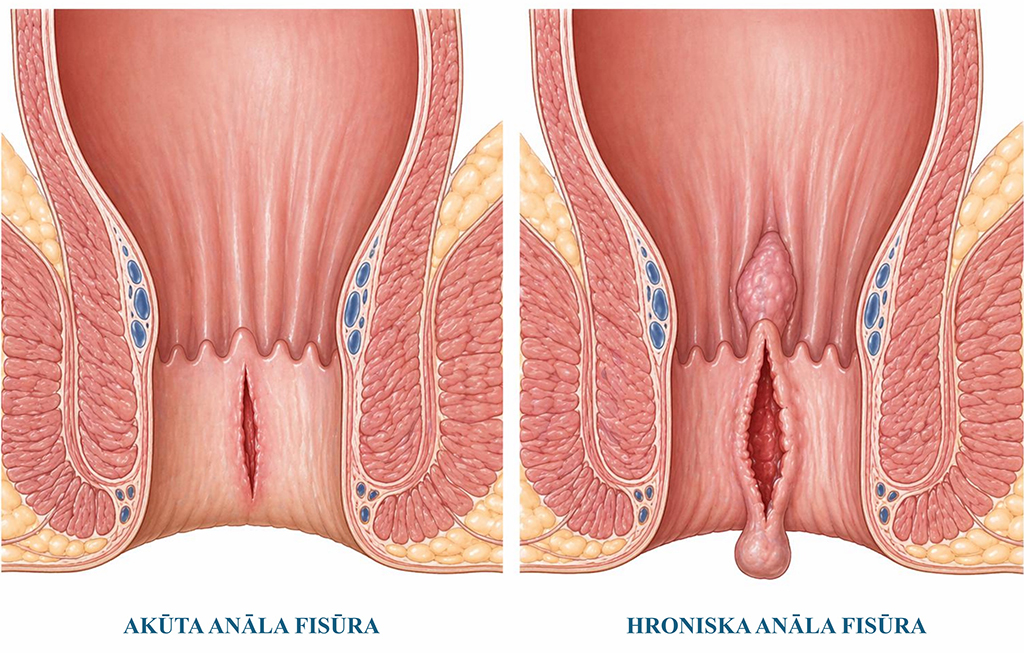
An anal fissure is an elongated tear in the mucosa of the canal, most often located on the anterior or posterior wall of the anal canal. It may be acute or chronic (Figure 1):
acute anal fissure – this is a recent, superficial, elongated tear in the mucosa of the anal canal, usually caused by recent mechanical trauma (most often due to hard stool). It is an early form of the disease in which structural tissue changes have not yet developed;
chronic anal fissure – this is a long-standing (usually >6–8 weeks) mucosal defect of the anal canal that does not heal spontaneously and is associated with persistently increased tone (spasm) of the internal anal sphincter and impaired blood supply. Unlike an acute fissure, the chronic form is characterized by secondary structural changes – a deep fissure, anal sphincter fibres are often visible at the base of the wound, at the ends of the fissure on the mucosal side there is a polypoid outgrowth, and at the skin margin – a fold or skin induration.
Figure 1. Anal fissure
What are the symptoms of an anal fissure?
The most characteristic symptoms are:
sharp, burning pain during and after defecation,
minor bleeding (most often – fresh blood on toilet paper);
a sensation of sphincter spasm (inability to relax during defecation);
itching or discomfort in the anal area
In chronic anal fissure, complaints are usually long-standing or recur very frequently and may be more intense.
What contributes to the development of an anal fissure?
Main contributing factors:
hard and/or infrequent bowel movements;
rapid or urgent defecation;
chronic diarrhoea;
increased anal sphincter tone (may be caused by other diseases);
inflammatory bowel diseases (for example, Crohn's disease).
The diagnosis is mainly clinical – it is based on the medical history (patient's complaints) and objective findings (digital rectal examination, proctoscopy). Additional investigations are performed only if there is suspicion of another pathology.
What complications can an anal fissure cause?
If an acute anal fissure is not treated, it becomes chronic, causing prolonged pain and associated impairment of quality of life. Occasionally, an anal fistula (a pathological tract connecting the bowel with the external environment) may develop on the background of an anal fissure.
What is the treatment of an anal fissure?
In acute anal fissure, first-line treatment is always conservative. It includes correction of bowel movements and local therapy (medications, sitz baths).
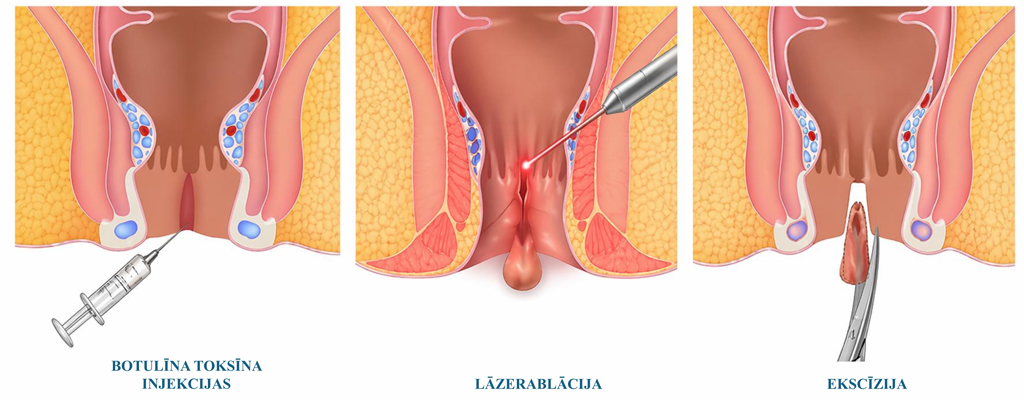
If the process is chronic, invasive treatment is required, which includes one of the treatment options (Figure 2):
local botulinum toxin injections – with the aim of reducing anal sphincter tone and improving blood supply, which consequently also improves healing;
laser ablation of an anal fissure – destruction of inflamed altered tissues;
excision of an anal fissure – excision of chronically altered tissues (scar tissue, polypoid mucosal outgrowth, skin fold).
If markedly increased anal sphincter tone and structural changes in the anal canal are observed, procedures are often combined – surgical removal of inflamed altered tissues and botulinum toxin injections are performed to promote successful wound healing in the postoperative period.
This website uses strictly necessary cookies to function. With your consent, statistical and social media cookies may also be used on this site.
Funkcionāls
Always active
Tehniskā glabāšana vai piekļuve ir noteikti nepieciešama leģitīmam mērķim, lai ļautu izmantot konkrētu pakalpojumu, ko skaidri pieprasījis abonents vai lietotājs, vai tikai ar mērķi veikt sakaru pārraidi elektronisko sakaru tīklā.
Settings
Tehniskā glabāšana vai piekļuve ir nepieciešama leģitīmam mērķim saglabāt preferences, kuras nav pieprasījis abonents vai lietotājs.
Statistika
The technical storage or access that is used exclusively for statistical purposes.Tehniskā krātuve vai piekļuve, kas tiek izmantota tikai anonīmiem statistikas nolūkiem. Bez tiesas pavēstes, jūsu interneta pakalpojumu sniedzēja brīvprātīgas atbilstības vai papildu ierakstiem no trešās puses, informāciju, kas tiek glabāta vai izgūta tikai šim nolūkam, parasti nevar izmantot, lai jūs identificētu.
Mārketings
Tehniskā uzglabāšana vai piekļuve ir nepieciešama, lai izveidotu lietotāju profilus reklāmas nosūtīšanai vai lai izsekotu lietotāja darbībām tīmekļa vietnē vai vairākās tīmekļa vietnēs līdzīgiem mārketinga mērķiem.