
Book a visit
+371 26 412 412
We Treat
We help you regain your health and quality of life by treating various gynaecological conditions. Our experienced specialists provide a personalised approach, guided by the latest medical standards and gentle treatment methods.

Anal fistula

What is an anal fistula?

An anal fistula is a pathological tract formed as a result of inflammation that connects the inside of the anal canal or rectum with the skin surface around the anus (Figure 1). It most often develops after spontaneous or surgical drainage of a perianal abscess (pus collection), when the inflammatory process does not resolve completely (50% of cases).
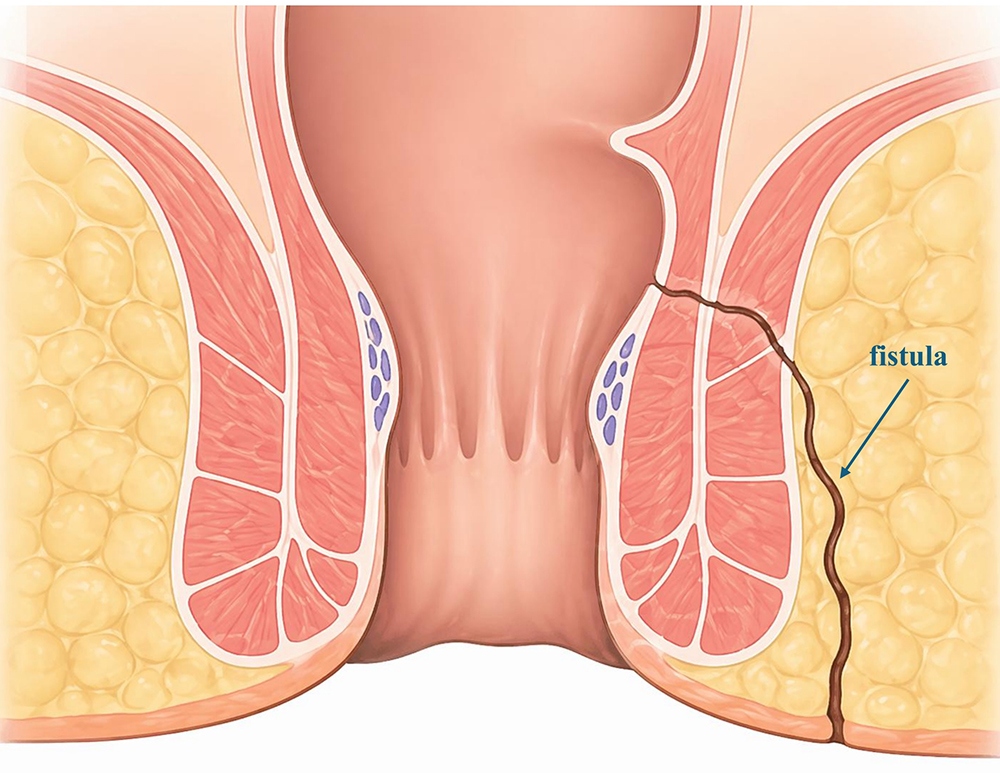
Anal fistula
Figure 1. Anal fistula

What are the symptoms of an anal fistula?

The most characteristic symptoms of an anal fistula are:

  • persistent or intermittent purulent or bloody discharge from the opening or from the skin near the anus;
  • skin irritation and itching;
  • pain, especially when sitting or during defecation;
  • swelling or redness around the anus;
  • recurrent formation of suppurations (abscesses) in the anal area.

What contributes to the development of an anal fistula?

The most common cause of an anal fistula is a previously experienced suppuration (abscess) in the anal region. This, in turn, is usually triggered by chronic constipation or diarrhoea (mechanical irritation), an anal fissure, chronic inflammatory bowel diseases (e.g., Crohn's disease), trauma or procedures in the anal region, poor local hygiene, weakened immunity and other diseases (e.g., diabetes mellitus, sexually transmitted diseases).

How is an anal fistula diagnosed?

The diagnosis of an anal fistula is established based on three main principles:

  • evaluation of the patient's complaints and disease course;
  • objective assessment – perineal inspection, digital rectal examination, proctoscopy;
  • radiological examinations – transrectal ultrasonography (TRUS) or magnetic resonance imaging (MRI) allow clarification of the course of an anal fistula and its relationship to the anal sphincter.

What complications can an anal fistula cause?

If an anal fistula is not treated, recurrent infectious exacerbations may develop in the anal zone (abscesses), resulting in branching of the fistula – a complex fistula, for which treatment is much more complicated, longer and has lower effectiveness rates. As a result of a prolonged chronic inflammatory process, persistent pain is most common; fecal incontinence and skin inflammation in the perineum may develop.

What is the treatment of an anal fistula?

Treatment of an anal fistula is surgical only. Taking into account the anatomical variability of an anal fistula (relationship to the anal sphincter, fistula course, number of internal and external openings, branching, presence of cavities, etc.), the surgical treatment approach is individualized. The choice of treatment is also determined by the underlying cause of the fistula (nonspecific fistula or caused by Crohn's disease) and the patient's risk factors. Surgical treatment of a fistula is performed in one or two stages.

There are several modifications of surgical treatment:

  • fistulotomy or excision of the fistula tract – opening or excision of the fistula tract;
  • seton placement – insertion of a special drainage loop into the fistula tract, which is often the first stage of treatment;
  • LIFT procedure – ligation and division of the fistula tract in the intersphincteric space;
  • FiLaC – laser ablation of the fistula tract;
  • closure of the internal fistula opening with a tissue flap – a mucosal flap or dermal (subcutaneous) flap is used to close the internal opening;
  • endoscopic treatment of the fistula tract – treatment of the fistula tract under optical (video-assisted) control.

Doctors to See


Working hours
Weekdays
8.00 - 19.00
Weekends
By appointment
Address
Medical centre New Hanza Med
Mihaila Tāla iela 1, Floor 4–6
Riga, Latvia
Contacts
info@vitolaklinika.lv
+371 26 412 412
+371 27 835 618
In partnership with:
Compensa_logotipsSeesam_logo
© 2026 Vītola klīnika
All rights reserved